
TL/DR; The anti-Flock campaign went viral because progressive communicators leaned in and poured fuel on existing organic energy to build massive social proof. The issue of mass surveillance is resonating because it taps into a core value, feels personal, showcases fascism, creates wins, and lends itself to fresh, constantly evolving visual content.
Flock is everywhere – both literally (there’s over 135,000 cameras all over the country) and online. It is safe to say that the conversation about Flock and mass surveillance has gone viral in the past month and it is the perfect example of what happens when progressive communicators pour fuel on organic energy.
On July 9th, I published Why We Need to Go All-In on Fighting the Fascist Surveillance State where I talked about how the local fights against surveillance infrastructure (flock cameras, data centers, Palantir contracts, and ICE warehouses) should be a strategic priority for the progressive movement. I argued that these local fights had bubbling organic energy and were an opportunity to dismantle a pillar of the fascist machine while building local organizing power – but only if we collectively leaned in. On July 24th, Magnitude Media noted that Flock posts were overperforming and also flagged the opportunity for the left to own and shape the surveillance conversation.
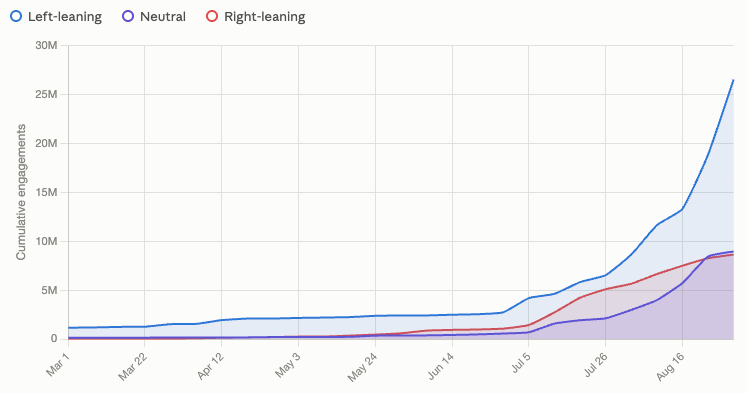
(Graph of cumulative engagements on Flock posts — data from Magnitude Media)
Well congratulations, friends - we collectively leaned in and, as a result, Flock has surged in the online discourse, with left-leaning accounts leading the way. By the end of August, 66% of people had heard something about Flock, which is incredible for a topic that had only just jumped into the conversation weeks earlier. Clips of people showing up at city council meetings, news of city after city canceling their contract, investigations exposing the widespread abuse and violation of privacy of the cameras, and a wave of viral videos of people vandalizing, blocking, or destroying cameras in their towns swept through the internet. During Deflock’s planned national week of action Aug 17-21, Flock became one of the top trending topics online for several days straight.
And the uprising shows no signs of slowing down – Americans are providing alibis and legal funds en masse to the people who destroy Flock cameras, doxxing the Flock CEO, preventing Axon (Flock’s competitor) from taking its place, and planning to Deflock America on Halloween night. In response, candidates and politicians on both sides of the aisle have had no choice but to respond to the issue. Bernie Sanders is introducing a bill to ban Flock, Ron DeSantis ordered the Florida Department of Transportation to remove all Flock cameras from state roadways within 30 days, and Texas Governor Greg Abbott banned state funding for Flock cameras after his challenger, Gina Hinojosa, released an anti-Flock ad. Trump was even asked about his position on Flock in a recent press conference. As a company, Flock seems to be in free fall. They have been forced to face the backlash and the CEO is begging for ‘compromise’ as Flock' scrambles to update its terms of service.
Progressive communicators have long lamented about our inability to drive the conversation. We are constantly responding to the latest catastrophe and often caught on defense against prevailing right-wing narratives. Why then were we able to collectively make Flock catch fire so quickly and effectively? There are several lessons we should learn from the success of this campaign.
1. Framing around privacy wins - no one wants to be watched.
The fight against mass surveillance has united left and right alike because it turns out no one really wants to be watched, regardless of their political ideology. Importantly, the value of privacy is central to our perceptions of liberty and freedom, which are the rare moral foundations that are universally held. Recent polling from Data For Progress found an overall -19 favorability for Flock surveillance cameras, with negative opinions across party, sex, age, and race. Doppler’s content testing also found videos about Flock to be “quite effective.”
2. Flock surveillance both showcases fascism and feels personal.
Last year, the Research Collaborative/ASO Communications did some important foundational research to understand how to activate and mobilize people against the Trump regime by studying those who had already been activated. They found that activated people were more likely to believe that we were living under fascism outside of the normal bounds of democracy. They also found that those who had been activated were more likely to have already felt some kind of personal impact – either themselves, their families, or their communities. Few issues are able to check both of these boxes so effectively, but Flock surveillance does (free speech is another). People can see these cameras in their own communities with their own eyes. Stories about Flock being used to hunt immigrants, activists, and abortion seekers help paint the fascist use cases for a centralized surveillance network. Given this, it’s no surprise that Flock has been activating people locally.
3. We poured fuel on existing organic energy instead of trying to make fetch happen.
Too often progressive organizations try to figure out how to activate people and bring awareness to an issue of their choosing. Instead, this is an example of what can happen if we flip that model and ask ourselves what is already activating people? Most of the public en masse might not have been paying attention to Flock before July, but people in towns and cities all across the country were. When my town cancelled its contract with Flock in May after we created massive public pressure, 63 cities had already ended their ALPR contracts. By the end of June, it had increased to 73 cities. As of today, that number is up to 153. The energy on the ground has been bubbling for a while and was ripe for the seizing.
4. We built social proof which allowed the conversation to snowball to virality.
People across the country have been fed up with the direction of this country and desperate to do something about it. Feeling little impact at the federal level, people naturally turned to something they could see and do something about. As news of cities steadily cancelling contracts started to spread, people in neighboring towns wondered if they could do the same. People organically started coordinating across jurisdictions, swapping lessons and strategies with their neighbors – building new local organizing networks that will endure. Since my town cancelled its contract in May, we’ve been supporting our neighbors in 3 nearby towns who are waging the same battle. Every win in any city in any state has been fuel for the cause, proving that ordinary people could make an impact in their town. Those wins – and that hope – have been desperately needed amidst all of the darkness. Once the conversation started taking off online, it became self-sustaining. Flock became a cool thing to talk about. When everyone is talking about something, suddenly everyone wants a piece of it. It’s the FOMO effect in action. In my opinion, nothing predicts success and virality like social proof.
5. The Flock conversation lends itself to great visual content.
Even though communicators often obsess about messaging, humans are fundamentally visual creatures. Our brains process visual information 10x faster than sound so the topics that can create good visual content are just going to do better. ICE has been such an effective topic online in part because of the constant stream of video content. Videos of impassioned residents at city council meetings, even sometimes in costume, and of people protesting or destroying Flock cameras kept popping up and going viral.
6. We could drive a core narrative with constantly refreshed news stories.
The news cycle moves fast and it is hard to sustain a conversation without constantly changing news hooks to drive a narrative. This is part of the reason the ICE conversation has been able to sustain for so long as well. Between city council meetings, new cancellations, protests, art, vandalism, and Flock getting caught in scandal after scandal after scandal after scandal after scandal after scandal, there has been enough fresh news to cycle through for weeks at a time.
7. Marrying organizing with communications is always more effective than when they operate in silos.
Another lesson that we learned from the ICE conversation applies here too. Our campaigns are most effective when organizing on the ground and communications strategies feed off of each other – when on-the-ground organizing provides fodder for content that communicators can work to amplify. Organizers and activists all across the country provided a glut of content opportunities through stunty activations and fiery city council speeches.
We should be proud of ourselves for owning the conversation on surveillance, particularly since it could have easily been co-opted by the anti-government “Don’t Tread on Me” side. In fact, the right has read the tea leaves and is clearly trying to jump on this ship too now. We’ve made surveillance into a midterm issue. People are meeting their neighbors, organizing in their local communities, and building durable infrastructure. We’re proving to people that they can take action and win against a system that feels rigged against us – that all hope is not lost. And at the same time, we are deconstructing the fascist machinery, one camera and contract at a time. This is how we build a movement to win. Keep going.
This is an excellent post, Jiggy! Thanks!
In addition, organizing about one topic builds a community ready to organize on the next. This is crucial.